
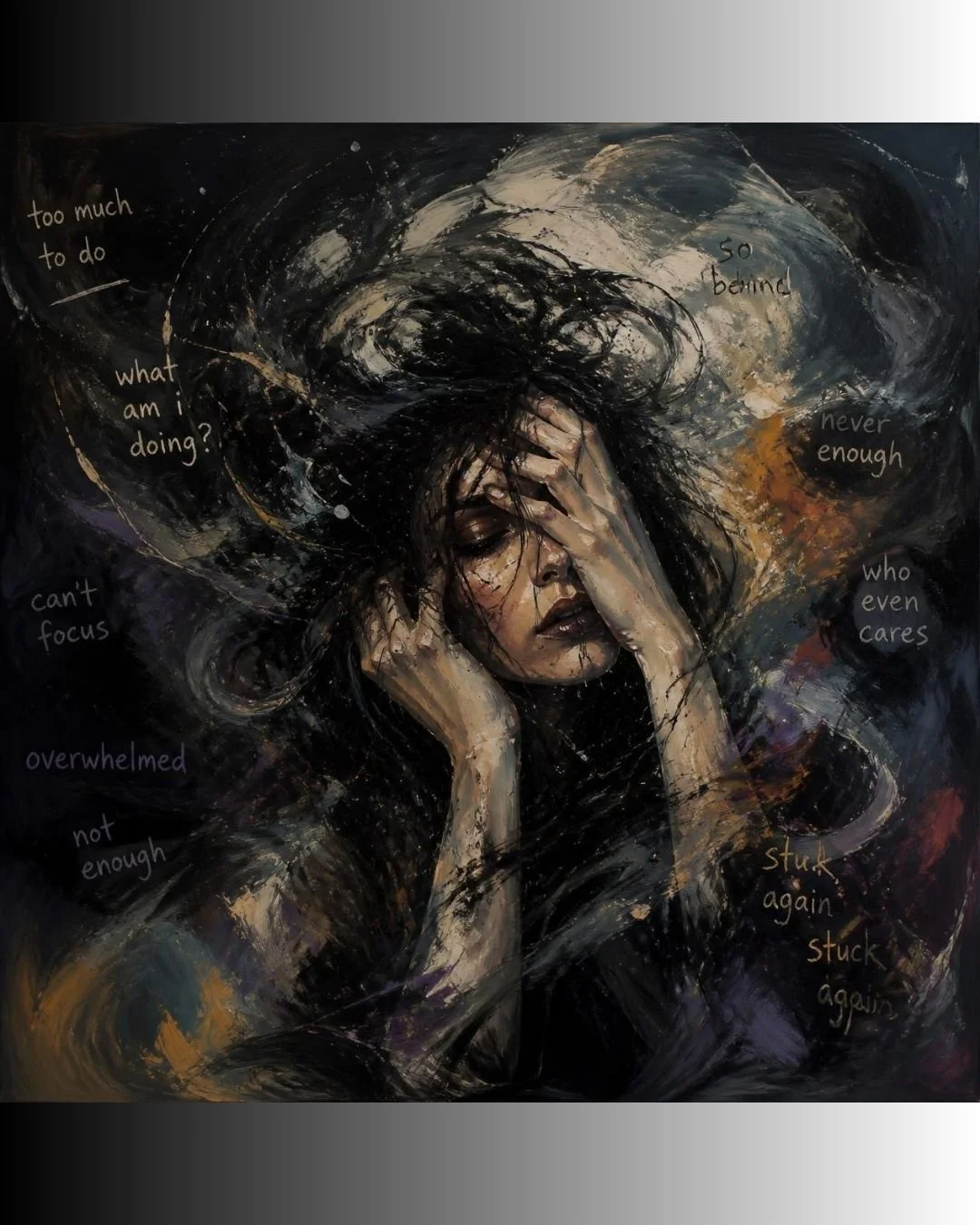
Is It ADHD or Anxiety? How to tell the difference, and when you can have both.
Struggling with concentration, restlessness, or procrastination, but unsure if the root cause is ADHD or anxiety? While both conditions can disrupt executive functioning and leave you feeling overwhelmed, they stem from different underlying mechanisms. Discover how to evaluate symptom patterns, mindsets, and developmental history to better understand what is driving your difficulties—and why it is so common to experience both.

When Faith, Trauma, and ADHD Collide: Religious Deconstruction and Healing for Neurodivergent Adults
One of the more interesting clinical questions here is what happens when ADHD exists inside an environment that demands extraordinary behavioral conformity... A child with ADHD may struggle to sit still, wait, follow length instructions, or complete repetitive tasks. In a flexible environment, these differences may be recognized as neurodevelopmental needs. In a highly authoritarian environment, they are more likely to be interpreted as character problems: you need to try harder; you are being disrespectful; why can't you just listen. When religion enters the equation, these messages acquire a further layer: you need to surrender this to God; you need to pray about your attitude; your heart is the problem.
For a child with ADHD, this produces a painful equation: my brain works differently, therefore I cannot consistently perform the way adults expect, therefore something is wrong with me morally. That equation is not an ADHD symptom. It is a meaning-making injury, and it is one of the more common things I see adults working to undo in therapy years, sometimes decades, later.

Is It ADHD, PTSD, or Both? Understanding Symptom Overlap
Have you ever wondered why your mind feels scattered, yet your body feels like it's on a "high alert" that you can't quite turn off? In my clinical practice, one of the most common points of confusion for adults is whether their restlessness and difficulty concentrating stem from ADHD, PTSD, or a complex blend of both.
While the outward behaviors—irritability, distractibility, and sleep disruption—look strikingly similar, the "why" inside your nervous system is very different. Is your attention wandering because of executive functioning differences, or is it scanning for safety? In my latest article, I explore how we can use frameworks like Polyvagal Theory to understand these patterns and, more importantly, how we can begin to regulate a nervous system that has been shaped by both neurodivergence and adversity.

The Cost of Masking: Neurodivergent Burnout and Autonomic Health
The 'invisible labor' of masking—suppressing neurodivergent traits to meet social expectations—represents a profound physiological tax. This excerpt explores how chronic social camouflaging leads to autonomic collapse and neurodivergent burnout, shifting the conversation from a medical deficit model to a biological reality of 'masking debt.'

When Fairness Feels Like a Threat: Justice Sensitivity and the ADHD Nervous System
For many adults with ADHD, fairness is not an abstract value—it is a felt experience. Moments that others may dismiss as minor or inconsequential can register in the ADHD nervous system as emotionally charged, morally urgent, and deeply destabilizing. A broken agreement, inconsistent rules, or witnessing someone being treated unjustly can trigger a cascade of physiological arousal, emotional overwhelm, and meaning-making that feels impossible to shut off.
This response is often misunderstood as overreactivity or emotional rigidity. In reality, it reflects a pattern known as justice sensitivity: a heightened emotional and nervous system response to perceived unfairness. Research suggests that individuals with ADHD experience elevated justice sensitivity across multiple dimensions, closely linked to emotional regulation difficulties, rejection sensitivity, and heightened threat detection. When fairness is violated, the body may respond as if safety itself has been compromised.
This article explores justice sensitivity through a neurobiological and psychological lens, examining why small injustices can feel so big for ADHDers, how justice sensitivity overlaps with Rejection Sensitive Dysphoria, and why these responses are not character flaws but biologically meaningful signals shaped by lived experience. Understanding this pattern opens the door to self-compassion, regulation, and healing—rather than shame.