

Is It ADHD or Anxiety? How to tell the difference, and when you can have both.
Struggling with concentration, restlessness, or procrastination, but unsure if the root cause is ADHD or anxiety? While both conditions can disrupt executive functioning and leave you feeling overwhelmed, they stem from different underlying mechanisms. Discover how to evaluate symptom patterns, mindsets, and developmental history to better understand what is driving your difficulties—and why it is so common to experience both.

Can ADHD Get Worse With Age? Why Adult ADHD Can Feel Harder in Midlife
Does ADHD Get Worse With Age? Why Adult ADHD Can Feel Harder in Midlife
While research shows core ADHD symptoms typically decrease across adulthood, many adults experience midlife as significantly more challenging. This increased struggle rarely stems from a worsening of the disorder itself. Instead, it is often driven by the loss of external structure, an accumulation of complex professional and personal responsibilities, and the eventual breakdown of long-term compensatory masking. Factors like chronic stress, sleep disruptions, normal cognitive aging, and midlife hormonal shifts can further strain executive functioning, making existing vulnerabilities feel far more severe.

The ADHD Iceberg: Understanding What May Exist Beneath the Observable Symptoms
While observable behaviors like distractibility and missed deadlines define traditional ADHD diagnoses, they tell only part of the story. The "ADHD Iceberg" illustrates how hidden cognitive labor, elaborate compensatory strategies, and emotional dysregulation often mask significant functional impairment—especially in high-achieving adults and women. Understanding ADHD requires looking past outward success to assess the true effort, energy, and internal toll required to maintain everyday life.

ADHD Paralysis: Understanding Why You Can Know What to Do and Still Feel Unable to Begin
There is a particular experience that many adults with ADHD describe with considerable frustration: they know what needs to be done, understand why it needs to be done, and may genuinely want to complete it, yet they cannot seem to initiate the behavior necessary to get started... ADHD paralysis generally refers to the subjective experience of being unable to initiate or engage in an intended activity despite recognizing that the activity needs to be completed.

When Faith, Trauma, and ADHD Collide: Religious Deconstruction and Healing for Neurodivergent Adults
One of the more interesting clinical questions here is what happens when ADHD exists inside an environment that demands extraordinary behavioral conformity... A child with ADHD may struggle to sit still, wait, follow length instructions, or complete repetitive tasks. In a flexible environment, these differences may be recognized as neurodevelopmental needs. In a highly authoritarian environment, they are more likely to be interpreted as character problems: you need to try harder; you are being disrespectful; why can't you just listen. When religion enters the equation, these messages acquire a further layer: you need to surrender this to God; you need to pray about your attitude; your heart is the problem.
For a child with ADHD, this produces a painful equation: my brain works differently, therefore I cannot consistently perform the way adults expect, therefore something is wrong with me morally. That equation is not an ADHD symptom. It is a meaning-making injury, and it is one of the more common things I see adults working to undo in therapy years, sometimes decades, later.

ADHD and Friendship in Adulthood: Why Connection Feels So Hard, and What Happens When Trust Gets Exploited
If you have ADHD, adult friendship often feels like a cycle of excitement, executive function exhaustion, and quiet grief. Research shows this isn't a personal flaw—it is a documented pattern rooted in communication mismatches, the cognitive toll of masking, and situational vulnerabilities that make neurodivergent trust easy to exploit. Understanding these dynamics is the first step toward building relationships that actually honor how your brain works.

When Your Clock Is Broken: Circadian Rhythm Disruption in ADHD and Its Trauma Amplification
When Your Clock Is Broken: The Exhausting Reality of ADHD, Trauma, and Insomnia
Ever been told to "just go to bed earlier" or try better "sleep hygiene"? For adults with ADHD and trauma, that advice doesn't just fail—it ignores biology. Emerging research reveals that ADHD is deeply tied to a delayed circadian rhythm, meaning the internal biological clock literally runs hours behind the rest of the world. When a history of trauma is layered on top, the nervous system remains on high alert all night, completely scrambling sleep architecture. This isn't a lack of discipline; it’s a biological "double hit" to the body's timing system. Discover why standard sleep advice fails this population, and how a trauma-sensitive, biologically informed approach can help restore felt safety and genuine rest.

The Body Keeps the Score, But Can't Find the Words: Interoception, ADHD, and Trauma
Ever feel fine until suddenly you're completely overwhelmed? For adults with ADHD and trauma, missing stress signals isn't a lack of discipline—it's a neurophysiological "double blind spot." Explore how diminished interoception delays distress cues, why standard "listen to your body" advice fails, and evidence-based, neurodivergent-affirming ways to safely reconnect.
Beyond Deficits: Toward a Meaning-Making Framework for Adult ADHD Care
A person can become measurably more functional through symptom-focused treatment and still feel fundamentally broken. Why standard adult ADHD care leaves identity-level wounds untouched—and how an integrated framework of logotherapy, narrative therapy, and neuroaffirmative practice offers true psychological repair. Read an excerpt from Part Four of this ongoing series.

The Diagnostic Gap Has Not Been Solved: Gender, Race, and the Inequitable Distribution of Recognition
The diagnostic gap in adult ADHD is not randomly distributed. It follows predictable patterns shaped by gender and race, determining not only who receives a diagnosis, but who is even considered for one in the first place.
Research increasingly shows that women are less likely to be identified in childhood and often arrive in clinical settings years later with complex secondary presentations—anxiety, depression, emotional dysregulation, and chronic self-doubt—before ADHD is ever considered. Similarly, racial disparities in diagnosis suggest that equivalent behavioral presentations are not interpreted through the same diagnostic lens across populations, leading to delayed, missed, or misdirected pathways to care.
The consequence of this gap is not only clinical delay, but narrative formation. In the absence of an explanatory framework, individuals often construct deeply personal and often painful interpretations of their struggles—stories of underperformance, character flaws, or chronic inadequacy. These narratives can persist for decades before being interrupted by accurate diagnosis.
Understanding ADHD through this lens shifts the conversation away from individual deficit and toward structural recognition: who gets seen, who gets believed, and who is granted access to explanation.

Adult ADHD: A Multi-Domain Clinical Reality
It is never just one thing. For adults with ADHD, the research documents what clinicians who work with this population already know intuitively: impairment does not stay contained within a single domain. An occupational setback becomes a relational strain. A relational strain becomes a depressive episode. A depressive episode compounds executive dysfunction — and the cycle continues. Bogdańska-Chomczyk et al. (2025) call this cascading impairment, and it is one of the most clinically significant — and most underaddressed — realities of adult ADHD in practice.

Adult ADHD: Bridging the Research-Practice Gap Through Developmentally Informed Assessment and Treatment
Somewhere between the research and the referral pad, adult ADHD got lost. Not because the science was weak — because the field was not looking. Cortese et al. (2025) confirm that up to 70% of individuals with childhood-onset ADHD continue to experience impairing symptoms as adults, even when full diagnostic criteria are no longer met. The clinical burden persists. What changes is how it presents — and how readily it gets missed.

When the Diagnosis Comes Late: Grief, Identity, and the Long Work of Meaning-Making After an Adult ADHD Diagnosis
Many adults expect relief after finally receiving an ADHD diagnosis. What they do not expect is grief. A late diagnosis can reshape how people understand their childhood, relationships, struggles, and sense of self. This article explores the complex emotional process that often follows an adult ADHD diagnosis, including grief, identity reconstruction, shame, relief, and the long work of making meaning from years spent misunderstood.

Designing Work Around an ADHD Brain: A Clinical and Neuropsychological Perspective
Conventional work structures often privilege a specific kind of mind—one that thrives on linear progression and consistent output. But for the ADHD brain, this "invisible architecture" can create a chronic experience of misalignment. Moving beyond the traditional deficit-based model, Dr. Cristina Louk explores the neuropsychological mechanisms of interest-based attention and how we can shift from remediating individuals to designing work that aligns with neurocognitive variability.

The Grief of a Late-In-Life ADHD Diagnosis: Reconsidering a Life Lived Without a Name
A late-in-life ADHD diagnosis rarely arrives as a discrete moment of clarity; instead, it reorganizes the psychological meaning of an entire life. While reframing years of "inconsistency" through a neurodevelopmental lens can bring relief, it also introduces a profound, recursive grief for the unlived life trajectory that might have been. This transition requires more than just new information—it demands a compassionate re-authoring of one’s identity and a somatic processing of the years spent in survival mode.

The Architectures of Over-Extension: ADHD, Anxiety, and the Success Trap
In the high-stakes environments of executive leadership and high-tech corridors, ADHD often defies the stereotypes of disorganization. Instead, it manifests as a sophisticated "success trap," where anxiety functions as a chemical surrogate for dopamine. In my latest article, The Architectures of Over-Extension, I explore the neurobiological and somatic costs of using chronic hyper-arousal to mask executive function deficits. While this "anxious mobilization" may yield significant career milestones, it often leads to profound nervous system exhaustion and a fragmented sense of self.

Somatic Healing for the Neurodivergent Body: Regulating a Biologically Noisy Nervous System
Adults with ADHD frequently describe an internal environment characterized by persistent activation. This experience is not limited to cognitive distractibility; it often includes physiological agitation, fluctuating energy states, and difficulty achieving a sense of embodied calm. When the nervous system is 'noisy,' the challenge is not simply sustaining attention—it is maintaining a stable internal state from which attention becomes possible. In this article, Dr. Cristina Louk explores how shifting the focus from top-down control toward bottom-up somatic regulation can quiet the noise and restore the conditions for focus.

Why Traditional Trauma-Focused Talk Therapies Might Fail the ADHD Brain
Adults with ADHD frequently encounter a particular form of therapeutic impasse when engaging in standard trauma-focused talk therapies. This impasse is not adequately explained by motivation, resistance, or lack of insight. Rather, it reflects a fundamental mismatch between the cognitive demands of traditional therapeutic models and the neurodevelopmental architecture of the ADHD brain.
Cognitive interventions rely on the client’s ability to retain and later apply abstract strategies introduced in session. For an individual with compromised working memory, these strategies may not consolidate effectively. The issue is not a lack of engagement during the session itself, but a breakdown in the transfer of learning across time and context...
From this perspective, the limitation of purely cognitive approaches becomes evident. Without first establishing autonomic stability, higher-order cognitive interventions may not be fully accessible.

The Relational Trauma of Growing Up Neurodivergent: Rebuilding Safety When You Feel “Too Much” or “Not Enough”
Many neurodivergent individuals grow up hearing they are either “too much” or “not enough.” These repeated messages act as chronic relational micro-traumas that gradually undermine a person’s sense of safety. When a child’s nervous system is continually tuned to expect criticism rather than comfort, even ordinary interactions can begin to register as threatening.
According to Polyvagal Theory, our nervous systems constantly scan for cues of safety or threat. If early experiences repeatedly signal relational danger—such as being shamed for natural traits—the body may default to defensive states like "fight-or-flight" or "freeze."
Healing is not about "fixing" a disorder, but about rebuilding the biological and psychological safety that was missing during development. By practicing somatic regulation and self-compassion, individuals can begin to release the internalized belief that they are inherently "wrong" and instead embrace their authentic selves.
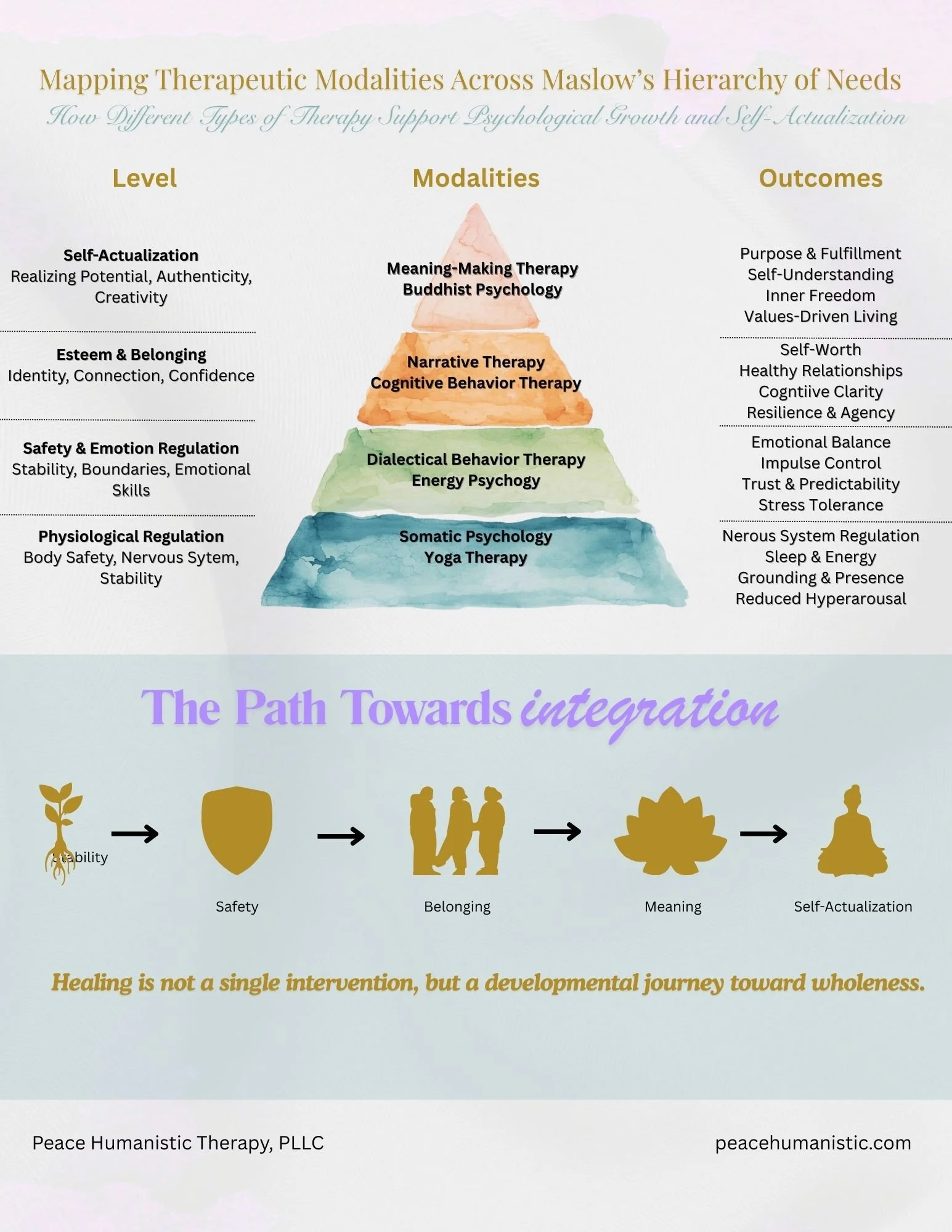
Mapping Therapeutic Modalities Across Maslow’s Hierarchy of Needs: How Different Types of Therapy Support Psychological Growth and Self-Actualization
Psychological healing rarely happens through a single insight or breakthrough. Instead, it tends to unfold through a developmental process in which the body, mind, relationships, and sense of meaning gradually come into alignment. One of the most enduring frameworks for understanding this process is Maslow’s hierarchy of needs, which proposes that human development moves through layered domains—from physiological regulation to emotional safety, relational belonging, identity formation, and ultimately self-actualization (Maslow, 1943).
In psychotherapy, this developmental perspective offers an important insight: not all therapeutic modalities operate at the same psychological level. Some approaches focus on stabilizing the nervous system and restoring a sense of physical safety. Others help individuals develop emotional regulation skills, reconstruct internal narratives, or explore deeper questions of meaning and purpose.
When these modalities are viewed through a developmental lens, they are no longer competing schools of thought but complementary tools supporting different layers of human growth.
For individuals navigating trauma, chronic stress, or ADHD, this framework can be particularly illuminating. Rather than asking “Which therapy is best?” the more helpful question may be:
“What level of development needs support right now?”
Understanding where you fall within this hierarchy can help guide therapeutic work toward interventions that support genuine integration rather than temporary symptom relief.
Read the full article to explore how different therapeutic approaches map across Maslow’s hierarchy—and how to identify what kind of support may best serve your current stage of growth.