
Mapping Therapeutic Modalities Across Maslow’s Hierarchy of Needs: How Different Types of Therapy Support Psychological Growth and Self-Actualization
Why Psychological Healing Often Requires Multiple Therapy Approaches
Psychological healing rarely occurs as a single insight or intervention. Rather, it unfolds as a developmental process in which basic physiological stability gradually gives rise to emotional regulation, relational security, identity formation, and ultimately a sense of meaning and purpose. One of the most enduring frameworks for conceptualizing this progression is Maslow’s hierarchy of needs, which proposes that human motivation tends to move through layered domains of development beginning with physiological survival and extending toward self-actualization and meaning (Maslow, 1943; Maslow, 1968).
Although Maslow’s model has often been simplified into a pyramid diagram, its underlying psychological insight remains clinically relevant. Individuals cannot consistently pursue higher forms of growth when foundational forms of safety, regulation, and belonging remain unstable. Trauma research and contemporary neuroscience echo this principle. When the nervous system is chronically dysregulated, cognitive insight alone rarely produces lasting change because the organism remains oriented toward survival rather than integration (Porges, 2011; van der Kolk, 2014).
For this reason, effective psychotherapy often requires multiple modalities operating at different levels of human functioning. Cognitive approaches may help reorganize thought patterns. Somatic interventions may stabilize autonomic arousal. Narrative approaches may reshape identity. Contemplative traditions may cultivate meaning and existential coherence.
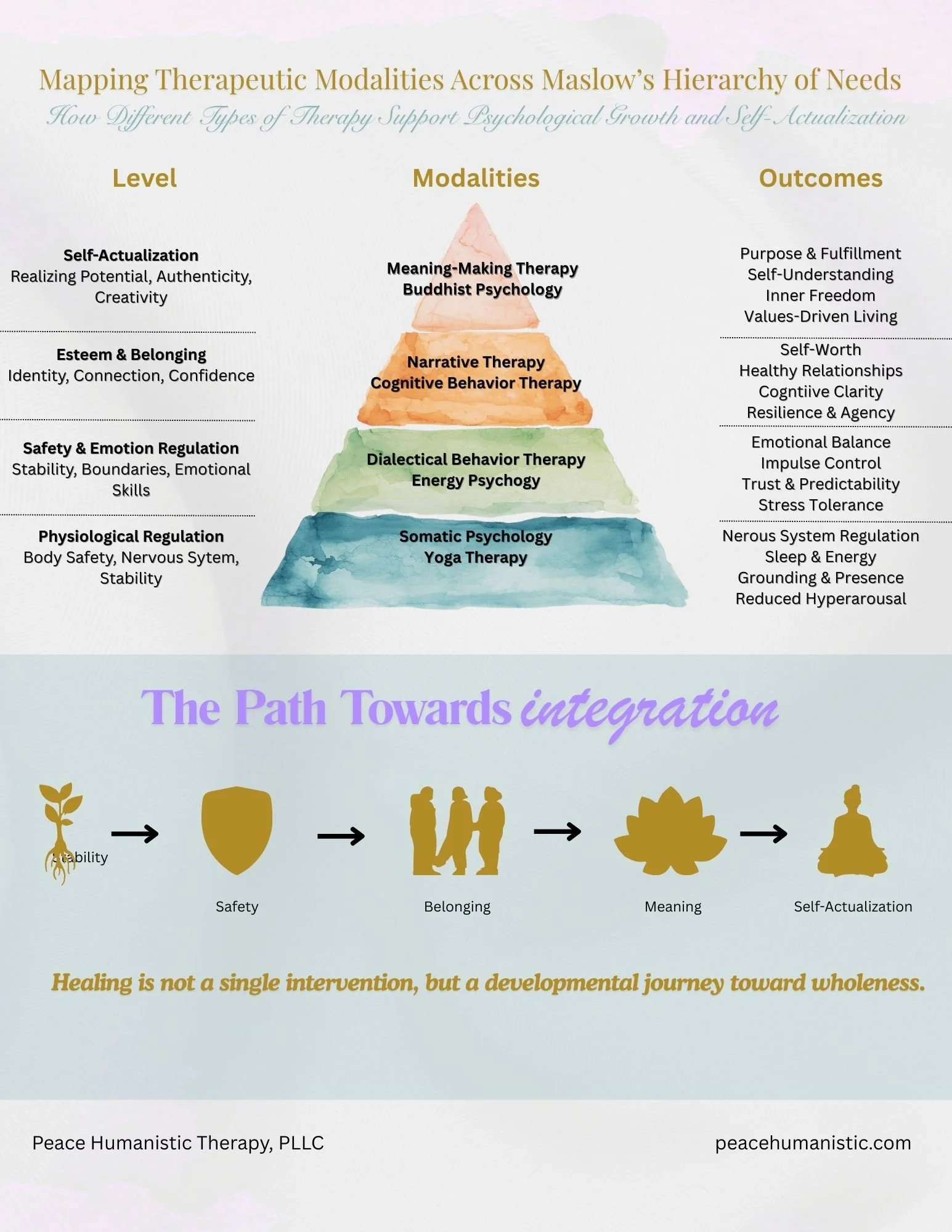
Viewed through this developmental lens, therapeutic modalities can be understood not as competing schools of thought but as complementary tools that support movement through different psychological layers of Maslow’s hierarchy. When integrated thoughtfully, they support the gradual movement from survival toward self-actualization.
Somatic Therapy and Yoga Therapy: Regulating the Nervous System at the Base of Maslow’s Hierarchy
At the base of Maslow’s hierarchy lie physiological needs. These include sleep, bodily regulation, and the maintenance of biological equilibrium. Although psychotherapy historically focused on cognition and behavior, contemporary trauma research increasingly recognizes that psychological distress often reflects dysregulation within the autonomic nervous system rather than purely cognitive dysfunction (Porges, 2011).
Two therapeutic modalities frequently operate at this foundational level: somatic psychology and yoga therapy.
Somatic psychology approaches psychological distress through the body’s sensory and autonomic systems. Rather than focusing exclusively on thoughts or narratives, it attends to patterns of muscular tension, breathing, posture, and visceral sensation that reflect underlying nervous system states (Ogden & Fisher, 2015). Individuals with chronic anxiety, trauma histories, or ADHD often experience persistent sympathetic activation or cycles of collapse and shutdown. Somatic interventions such as grounding, interoceptive awareness, and titrated exposure to bodily sensation allow the nervous system to gradually experience regulation.
Yoga therapy operates in a similar physiological domain, although its origins lie in contemplative traditions rather than Western psychology. Controlled breathing practices, gentle movement, and postural alignment influence vagal tone and parasympathetic activation. Clinical studies increasingly demonstrate that trauma-sensitive yoga can improve emotional regulation, reduce symptoms of anxiety and depression, and increase bodily awareness (Emerson et al., 2020).
The tangible outcomes associated with these modalities include improved sleep, decreased physiological hyperarousal, greater capacity for emotional regulation, and increased tolerance for internal sensations. These changes may appear modest on the surface, yet they represent an essential developmental shift. When the body experiences safety, the mind becomes more capable of reflection.
DBT and Energy Psychology: Therapies That Build Emotional Safety and Regulation
Once physiological stability is established, attention often shifts toward psychological safety and emotional regulation. This level of Maslow’s hierarchy involves the capacity to experience the world as predictable and manageable rather than threatening.
Two therapeutic approaches frequently operate within this domain: Dialectical Behavior Therapy (DBT) and energy psychology interventions.
DBT was originally developed to address chronic emotional dysregulation and has since become widely used for individuals who struggle with intense affective states (Linehan, 2015). The model integrates behavioral skills training with mindfulness practices. Clients learn techniques for distress tolerance, emotional regulation, and interpersonal effectiveness. Rather than attempting to suppress emotion, DBT teaches individuals to observe emotional experiences without being overwhelmed by them.
Energy psychology represents a more controversial but increasingly researched area of intervention. Techniques such as Emotional Freedom Techniques (EFT) combine elements of cognitive exposure with somatic stimulation through acupoint tapping. Some studies suggest that these interventions may reduce physiological markers of stress and improve emotional regulation, although research in this area continues to evolve (Church et al., 2018).
In clinical practice, individuals often report tangible changes after developing emotional regulation skills. They may experience fewer impulsive reactions, improved ability to pause before responding, and a greater sense of internal stability. These shifts create the psychological conditions necessary for deeper relational and identity work.
Narrative Therapy and CBT: Rewriting Identity, Beliefs, and Personal Story
Maslow identified belonging and relational connection as the next developmental layer. Humans construct identity through relationships and shared meaning. When relational wounds occur, particularly in early development, individuals may carry persistent narratives of shame, inadequacy, or exclusion.
Two therapeutic modalities often address this level of development: Narrative Therapy and Cognitive Behavioral Therapy (CBT).
Narrative therapy views identity as shaped through the stories individuals construct about themselves and their lives (White & Epston, 1990). Rather than treating the person as the problem, the approach externalizes the problem and invites clients to examine how dominant cultural narratives, trauma histories, or internalized criticism have shaped their self-concept. Through therapeutic dialogue, individuals begin to identify alternative stories that reflect resilience, competence, and agency.
CBT addresses related processes through a cognitive framework. It examines the automatic thoughts and belief structures that influence emotional experience and behavior (Beck, 2011). Many individuals with depression, anxiety, or trauma histories develop cognitive distortions such as catastrophizing, personalization, or global self-criticism. CBT interventions help clients identify these patterns and test them against evidence and alternative interpretations.
Although the theoretical language differs, both approaches contribute to the reconstruction of identity. Individuals who once described themselves as fundamentally flawed may begin to view their struggles within broader developmental contexts.
The practical outcomes include improved self-esteem, more balanced thinking patterns, and increased relational confidence. When individuals no longer experience themselves as fundamentally defective, they become more capable of engaging in authentic relationships.
Meaning-Making Therapy, Buddhist Psychology, and Hypnotherapy: Approaches That Support Self-Actualization
The highest levels of Maslow’s hierarchy involve self-actualization and meaning. At this stage, psychological work shifts from symptom reduction toward existential exploration. Questions of purpose, identity, creativity, and spiritual orientation often become central.
Several modalities contribute to this level of development: meaning-making therapy, Buddhist psychology, and hypnotherapy.
Meaning-making approaches draw from existential and humanistic psychology. They emphasize the human capacity to interpret experience and construct purpose even in the presence of suffering (Frankl, 1963). In therapy, individuals explore how adversity has shaped their values, identity, and life direction.
Buddhist psychology offers complementary insights regarding the nature of suffering, impermanence, and awareness. Practices derived from contemplative traditions cultivate mindfulness, compassion, and non-attachment to rigid identity structures. Research indicates that mindfulness-based interventions can reduce rumination, improve emotional regulation, and enhance psychological well-being (Kabat-Zinn, 2015).
Hypnotherapy can also operate within this domain when used for guided imagery, identity exploration, or the reinforcement of adaptive beliefs. By accessing states of focused attention, individuals may explore symbolic imagery, future-oriented goals, or internal resources that remain less accessible during ordinary cognitive processing (Lynn & Kirsch, 2006).
The outcomes associated with these approaches often include increased psychological flexibility, stronger alignment with personal values, and a more coherent sense of life direction.
Integrative Therapy: How Different Modalities Work Together in Psychological Healing
Maslow described self-actualization not as a final destination but as an ongoing process of becoming (Maslow, 1968).
When viewed developmentally, the therapeutic modalities described above function as complementary layers of intervention. Somatic and yoga-based approaches support physiological regulation. DBT and energy psychology strengthen emotional stability and safety. Narrative therapy and CBT reconstruct identity and relational meaning. Meaning-making therapy, Buddhist psychology, and hypnotherapy cultivate purpose, awareness, and integration.
Rather than competing approaches, they represent different entry points into the complex architecture of human development. Effective psychotherapy frequently involves moving fluidly between these levels depending on the needs of the individual.
A Clinical Perspective: Why Therapy Must Match the Client’s Stage of Psychological Development
In clinical practice, progress often occurs when therapy respects the sequence of psychological development. Attempts to explore meaning or purpose may feel premature for individuals whose nervous systems remain chronically dysregulated. Conversely, individuals who have developed strong emotional regulation skills may begin to feel constrained by purely symptom-focused approaches.
An integrative framework allows therapy to evolve alongside the client’s developmental trajectory. Early sessions may focus on stabilization and regulation. Later work may explore identity, purpose, and personal values. This gradual progression mirrors the movement through Maslow’s hierarchy itself.
Practical Implications: Choosing the Right Therapy for Emotional Regulation, Trauma, and Personal Growth
Several practical principles emerge from this developmental perspective.
First, healing often requires attention to the body as well as the mind. Regulation of the nervous system creates the foundation upon which cognitive and relational work becomes possible.
Second, identity is shaped through narrative. Helping individuals examine and reconstruct their personal stories can significantly influence emotional well-being.
Third, psychological growth ultimately involves meaning. Many individuals seek therapy not only to reduce distress but to understand themselves more fully and live in greater alignment with their values.
How Do I Know Where I Fall in Maslow’s Hierarchy?
One of the most common questions people ask when seeking therapy is not simply “Which therapy works?” but rather “Which type of support do I need right now?”
Maslow’s hierarchy can provide a useful developmental lens for answering this question. Psychological growth often unfolds in layers. When one layer becomes unstable, it can influence the levels above it. For example, individuals whose nervous systems remain chronically dysregulated may find it difficult to engage in cognitive restructuring or meaning-making work because their bodies remain oriented toward survival rather than reflection (Porges, 2011; van der Kolk, 2014).
For this reason, identifying the primary level of challenge can help guide therapeutic focus. The following reflective prompts can help individuals consider where their current experience may fall within this developmental framework.
Questions for Identifying Your Current Level of Need
1. Physiological Regulation and Nervous System Stability
If challenges exist at this level, individuals often experience persistent physical dysregulation. The body may remain in states of hyperarousal (fight or flight) or shutdown (freeze).
You may benefit from somatic therapy, trauma-informed yoga, or body-based interventions if you frequently notice:
Chronic fatigue or difficulty sleeping
Persistent physical tension or restlessness
Feeling easily overwhelmed by sensory input
A sense that your body never fully relaxes
Sudden emotional reactions that feel physically driven rather than cognitively chosen
Reflective questions:
Does my body regularly feel safe and calm?
When I am stressed, can I return to a regulated state within a reasonable period of time?
Do I feel connected to my physical sensations, or do I tend to feel disconnected from my body?
When regulation improves, individuals often report increased clarity of thought and emotional stability.
2. Emotional Safety and Regulation
At the next level of development, the focus shifts toward emotional stability and the capacity to tolerate distress.
Individuals who struggle in this area may experience:
Rapid mood shifts or intense emotional reactions
Difficulty tolerating uncertainty or distress
Impulsive responses during emotional conflict
A strong need to avoid uncomfortable feelings
Therapeutic approaches such as Dialectical Behavior Therapy (DBT), emotional regulation training, or certain energy psychology techniques often help individuals build skills at this stage (Linehan, 2015).
Reflective questions:
Do my emotions often feel overwhelming or difficult to manage?
When I become upset, do I have reliable tools that help me regulate?
Am I able to pause before reacting during emotional conflict?
When emotional safety develops, individuals often gain the stability needed to explore deeper relational patterns.
3. Belonging, Identity, and Self-Concept
At this level of Maslow’s hierarchy, psychological work often centers on identity, relationships, and internal narratives.
Individuals who experience difficulty in this domain may notice:
Persistent self-criticism or feelings of inadequacy
Fear of rejection or difficulty trusting relationships
A sense of not belonging or feeling fundamentally “different”
Internal narratives shaped by shame or past relational wounds
Therapeutic approaches such as Narrative Therapy and Cognitive Behavioral Therapy (CBT) often support exploration and reconstruction of identity (Beck, 2011; White & Epston, 1990).
Reflective questions:
What stories do I tend to tell about myself and my past?
Do I often interpret events through a lens of self-blame or inadequacy?
Do I feel secure in my relationships, or do I frequently anticipate rejection?
When individuals begin to revise limiting narratives, they often develop greater confidence and relational authenticity.
4. Meaning, Purpose, and Self-Actualization
At the highest levels of Maslow’s hierarchy, the focus shifts toward existential questions about purpose, authenticity, and fulfillment.
Individuals exploring this stage often ask:
What kind of life feels most meaningful to me?
How can I align my daily actions with my values?
What unique contributions do I feel called to make?
Therapeutic approaches grounded in humanistic psychology, meaning-making therapy, contemplative practices, and hypnotherapy can support exploration at this level (Frankl, 1963; Kabat-Zinn, 2015).
Reflective questions:
Do I feel connected to a deeper sense of purpose?
Am I living in alignment with my core values?
What experiences make me feel most authentically myself?
Work at this stage often focuses less on symptom reduction and more on cultivating meaning, creativity, and psychological integration.
A Key Insight: People Often Move Between Levels
Although Maslow’s hierarchy is often depicted as a pyramid, real psychological life is rarely linear. Individuals frequently move between levels depending on life circumstances.
For example:
Chronic stress may temporarily destabilize physiological regulation.
Relationship conflict may activate identity-based wounds.
Major life transitions may trigger questions of meaning and purpose.
Rather than viewing these shifts as setbacks, they can be understood as natural fluctuations within a dynamic developmental process.
An integrative therapeutic approach allows clinicians to move fluidly between levels—supporting nervous system regulation when necessary, strengthening emotional skills when needed, and exploring identity or meaning when the client is ready.
When Therapy Works Best
Therapy tends to be most effective when the intervention matches the level of development that requires attention.
For example:
Individuals experiencing chronic nervous system dysregulation often benefit first from somatic and body-based therapies.
Those navigating emotional volatility may benefit from skills-based approaches such as DBT.
Individuals struggling with identity or internal narratives may benefit from narrative or cognitive therapies.
Those seeking deeper purpose may benefit from humanistic or contemplative approaches.
When the level of intervention aligns with the individual’s current needs, therapy becomes less about “fixing problems” and more about supporting the natural movement toward psychological integration and growth.
Frequently Asked Questions About Therapy and Maslow’s Hierarchy of Needs
What type of therapy helps regulate the nervous system?
Somatic therapies and trauma-sensitive yoga are commonly used to help regulate the autonomic nervous system. These approaches increase interoceptive awareness, support vagal tone, and reduce chronic hyperarousal.
Which therapies help people find meaning and purpose in life?
Meaning-making therapy, existential therapy, Buddhist psychology, and hypnotherapy often help individuals explore values, identity, and life direction.
How do therapists choose which modality to use?
Therapists often consider the client’s level of psychological stability. Early treatment may focus on regulation and emotional safety, while later stages of therapy may explore identity development and meaning.
Can different types of therapy be combined?
Yes. Many clinicians use integrative approaches that combine cognitive, somatic, and meaning-centered therapies depending on the needs of the client.
Conclusion: How Integrative Therapy Supports Movement Toward Self-Actualization
Maslow’s hierarchy continues to offer a valuable framework for understanding psychological growth. Healing often unfolds through successive layers of development that include physiological regulation, emotional safety, relational belonging, and the search for meaning.
When therapeutic modalities are viewed through this developmental lens, their differences become less important than their complementary functions. Each approach addresses a distinct dimension of human experience. Together they support the gradual movement toward greater psychological integration.
For individuals navigating ADHD, trauma histories, or chronic stress, this integrative perspective can be particularly helpful. Rather than asking which therapy is best, the more useful question may be which level of development requires attention at this stage of life.
If the themes explored in this article resonate with your experience, working with a qualified mental health professional can provide a structured space for exploring these questions and supporting ongoing psychological growth.
About Dr. Cristina Louk – Licensed Mental Health Counselor and Holistic Therapist
Dr. Cristina Louk is a Licensed Mental Health Counselor (LMHC) in Washington and a Registered Yoga Teacher (RYT200/CYT500) dedicated to guiding adults toward holistic well-being and transformative healing. With a BS in Psychology, an MA, and a PhD in Clinical Psychology, Dr. Louk brings both deep academic knowledge and extensive clinical experience to her private practice, Peace Humanistic Therapy, PLLC, founded in 2021. She has been supporting individuals in navigating mental health challenges since 2017.
Dr. Louk specializes in adult ADHD, trauma, anxiety, and neurodevelopmental assessments including ADHD and autism spectrum disorder. Her work combines rigorous clinical assessment with holistic therapeutic approaches, including yoga therapy, breathwork, and somatic interventions, helping clients regulate their nervous system and strengthen emotional resilience.
With experience as a director of a supported living agency, Dr. Louk has worked extensively with individuals with co-occurring conditions, giving her a unique perspective on complex mental health needs. She also serves as President-Elect of the Washington Mental Health Counselors Association, where she leads initiatives for professional growth and continuing education.
A lifelong practitioner of ballet and yoga, Dr. Louk integrates movement-based healing, meditation, and the Yoga Sutras into therapy, offering a mind-body approach for adults managing ADHD and trauma. Her personal experience with ADHD and a dysregulated nervous system informs her empathetic, individualized care.
If you live in Washington State and are seeking comprehensive mental health therapy or neurodevelopmental assessment, Dr. Louk provides personalized, holistic treatment plans designed to support your growth, clarity, and emotional well-being.
Contact Peace Humanistic Therapy today to schedule your consultation and start your journey toward lasting healing.
References
Beck, J. S. (2011). Cognitive behavior therapy: Basics and beyond. Guilford Press.
Church, D., Stapleton, P., Yang, A., Gallo, F., & Nelms, J. (2018). Clinical EFT as an evidence-based practice for the treatment of psychological and physiological conditions. Psychology, 9(6), 1345–1363.
Emerson, D., Sharma, R., Chaudhry, S., & Turner, J. (2020). Trauma-sensitive yoga: Principles, practice, and research. Journal of Trauma & Dissociation, 21(4), 472–489.
Frankl, V. (1963). Man’s search for meaning. Beacon Press.
Kabat-Zinn, J. (2015). Mindfulness. Hachette Books.
Linehan, M. (2015). DBT skills training manual. Guilford Press.
Maslow, A. (1943). A theory of human motivation. Psychological Review, 50, 370–396.
Maslow, A. (1968). Toward a psychology of being. Van Nostrand.
Ogden, P., & Fisher, J. (2015). Sensorimotor psychotherapy. Norton.
Porges, S. (2011). The polyvagal theory. Norton.
van der Kolk, B. (2014). The body keeps the score. Viking.
White, M., & Epston, D. (1990). Narrative means to therapeutic ends. Norton.
