

The Body Keeps the Score, But Can't Find the Words: Interoception, ADHD, and Trauma
Ever feel fine until suddenly you're completely overwhelmed? For adults with ADHD and trauma, missing stress signals isn't a lack of discipline—it's a neurophysiological "double blind spot." Explore how diminished interoception delays distress cues, why standard "listen to your body" advice fails, and evidence-based, neurodivergent-affirming ways to safely reconnect.

Why Traditional Trauma-Focused Talk Therapies Might Fail the ADHD Brain
Adults with ADHD frequently encounter a particular form of therapeutic impasse when engaging in standard trauma-focused talk therapies. This impasse is not adequately explained by motivation, resistance, or lack of insight. Rather, it reflects a fundamental mismatch between the cognitive demands of traditional therapeutic models and the neurodevelopmental architecture of the ADHD brain.
Cognitive interventions rely on the client’s ability to retain and later apply abstract strategies introduced in session. For an individual with compromised working memory, these strategies may not consolidate effectively. The issue is not a lack of engagement during the session itself, but a breakdown in the transfer of learning across time and context...
From this perspective, the limitation of purely cognitive approaches becomes evident. Without first establishing autonomic stability, higher-order cognitive interventions may not be fully accessible.
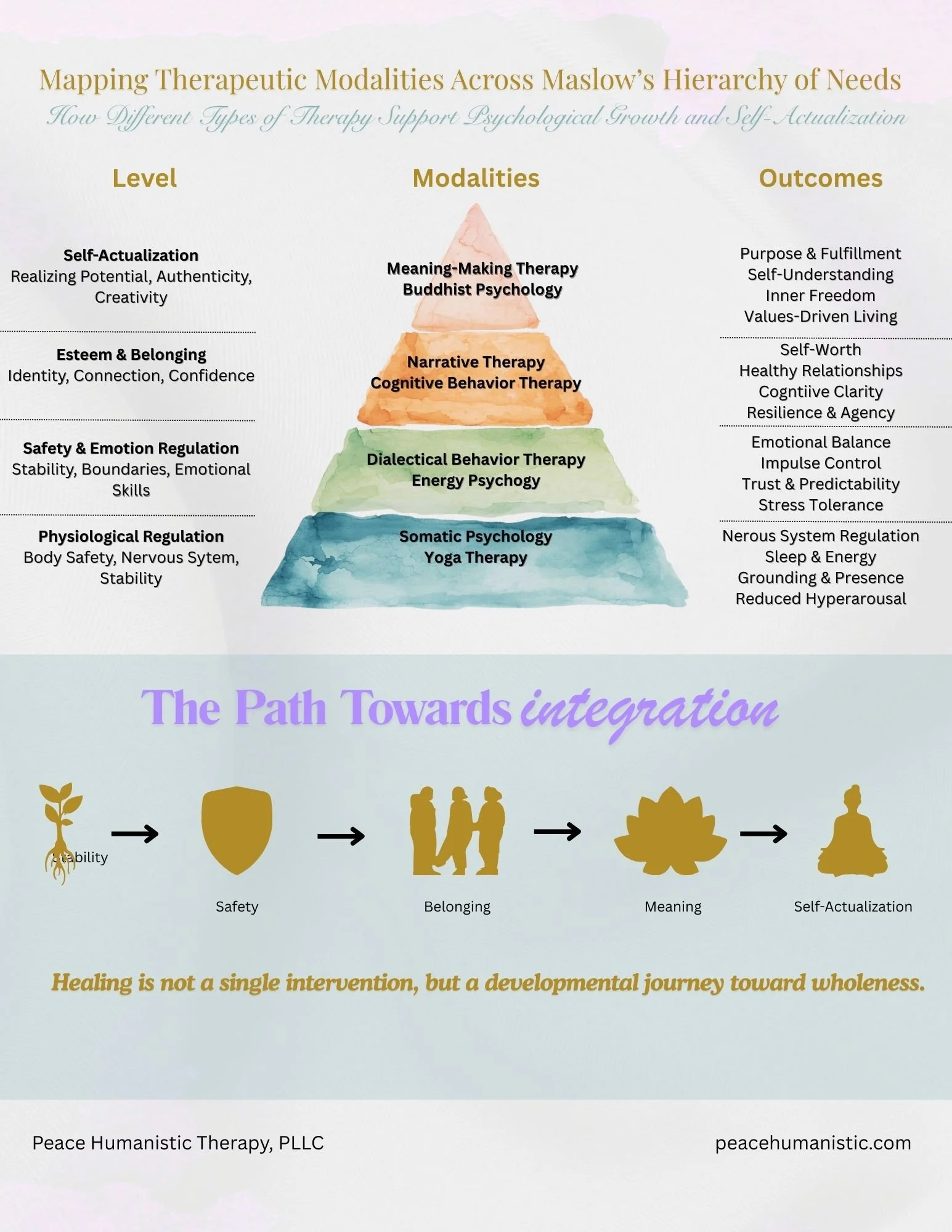
Mapping Therapeutic Modalities Across Maslow’s Hierarchy of Needs: How Different Types of Therapy Support Psychological Growth and Self-Actualization
Psychological healing rarely happens through a single insight or breakthrough. Instead, it tends to unfold through a developmental process in which the body, mind, relationships, and sense of meaning gradually come into alignment. One of the most enduring frameworks for understanding this process is Maslow’s hierarchy of needs, which proposes that human development moves through layered domains—from physiological regulation to emotional safety, relational belonging, identity formation, and ultimately self-actualization (Maslow, 1943).
In psychotherapy, this developmental perspective offers an important insight: not all therapeutic modalities operate at the same psychological level. Some approaches focus on stabilizing the nervous system and restoring a sense of physical safety. Others help individuals develop emotional regulation skills, reconstruct internal narratives, or explore deeper questions of meaning and purpose.
When these modalities are viewed through a developmental lens, they are no longer competing schools of thought but complementary tools supporting different layers of human growth.
For individuals navigating trauma, chronic stress, or ADHD, this framework can be particularly illuminating. Rather than asking “Which therapy is best?” the more helpful question may be:
“What level of development needs support right now?”
Understanding where you fall within this hierarchy can help guide therapeutic work toward interventions that support genuine integration rather than temporary symptom relief.
Read the full article to explore how different therapeutic approaches map across Maslow’s hierarchy—and how to identify what kind of support may best serve your current stage of growth.

When Fairness Feels Like a Threat: Justice Sensitivity and the ADHD Nervous System
For many adults with ADHD, fairness is not an abstract value—it is a felt experience. Moments that others may dismiss as minor or inconsequential can register in the ADHD nervous system as emotionally charged, morally urgent, and deeply destabilizing. A broken agreement, inconsistent rules, or witnessing someone being treated unjustly can trigger a cascade of physiological arousal, emotional overwhelm, and meaning-making that feels impossible to shut off.
This response is often misunderstood as overreactivity or emotional rigidity. In reality, it reflects a pattern known as justice sensitivity: a heightened emotional and nervous system response to perceived unfairness. Research suggests that individuals with ADHD experience elevated justice sensitivity across multiple dimensions, closely linked to emotional regulation difficulties, rejection sensitivity, and heightened threat detection. When fairness is violated, the body may respond as if safety itself has been compromised.
This article explores justice sensitivity through a neurobiological and psychological lens, examining why small injustices can feel so big for ADHDers, how justice sensitivity overlaps with Rejection Sensitive Dysphoria, and why these responses are not character flaws but biologically meaningful signals shaped by lived experience. Understanding this pattern opens the door to self-compassion, regulation, and healing—rather than shame.