
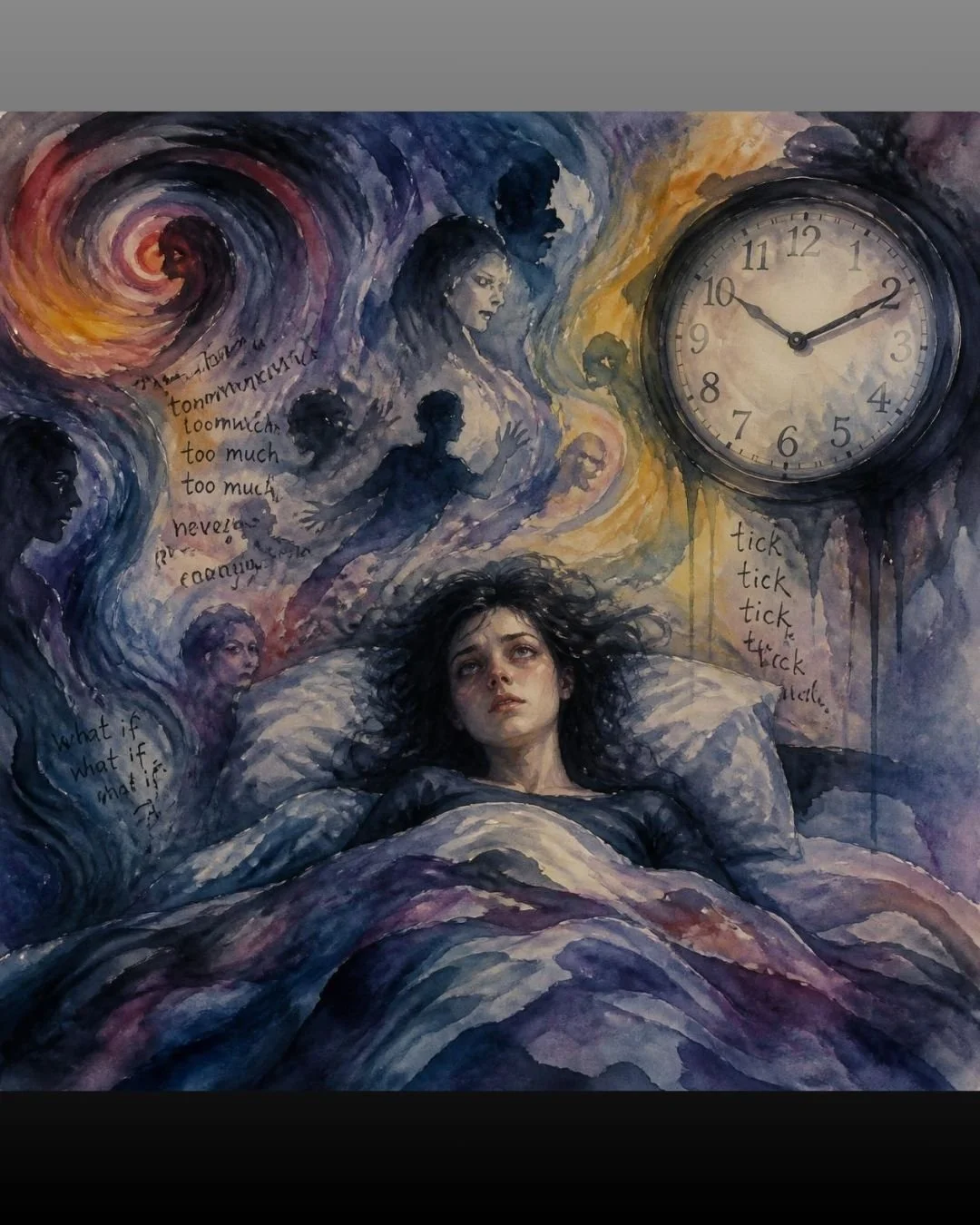
When Your Clock Is Broken: Circadian Rhythm Disruption in ADHD and Its Trauma Amplification
When Your Clock Is Broken: The Exhausting Reality of ADHD, Trauma, and Insomnia
Ever been told to "just go to bed earlier" or try better "sleep hygiene"? For adults with ADHD and trauma, that advice doesn't just fail—it ignores biology. Emerging research reveals that ADHD is deeply tied to a delayed circadian rhythm, meaning the internal biological clock literally runs hours behind the rest of the world. When a history of trauma is layered on top, the nervous system remains on high alert all night, completely scrambling sleep architecture. This isn't a lack of discipline; it’s a biological "double hit" to the body's timing system. Discover why standard sleep advice fails this population, and how a trauma-sensitive, biologically informed approach can help restore felt safety and genuine rest.

Somatic Healing for the Neurodivergent Body: Regulating a Biologically Noisy Nervous System
Adults with ADHD frequently describe an internal environment characterized by persistent activation. This experience is not limited to cognitive distractibility; it often includes physiological agitation, fluctuating energy states, and difficulty achieving a sense of embodied calm. When the nervous system is 'noisy,' the challenge is not simply sustaining attention—it is maintaining a stable internal state from which attention becomes possible. In this article, Dr. Cristina Louk explores how shifting the focus from top-down control toward bottom-up somatic regulation can quiet the noise and restore the conditions for focus.

Is It ADHD, PTSD, or Both? Understanding Symptom Overlap
Have you ever wondered why your mind feels scattered, yet your body feels like it's on a "high alert" that you can't quite turn off? In my clinical practice, one of the most common points of confusion for adults is whether their restlessness and difficulty concentrating stem from ADHD, PTSD, or a complex blend of both.
While the outward behaviors—irritability, distractibility, and sleep disruption—look strikingly similar, the "why" inside your nervous system is very different. Is your attention wandering because of executive functioning differences, or is it scanning for safety? In my latest article, I explore how we can use frameworks like Polyvagal Theory to understand these patterns and, more importantly, how we can begin to regulate a nervous system that has been shaped by both neurodivergence and adversity.