
When Your Clock Is Broken: Circadian Rhythm Disruption in ADHD and Its Trauma Amplification
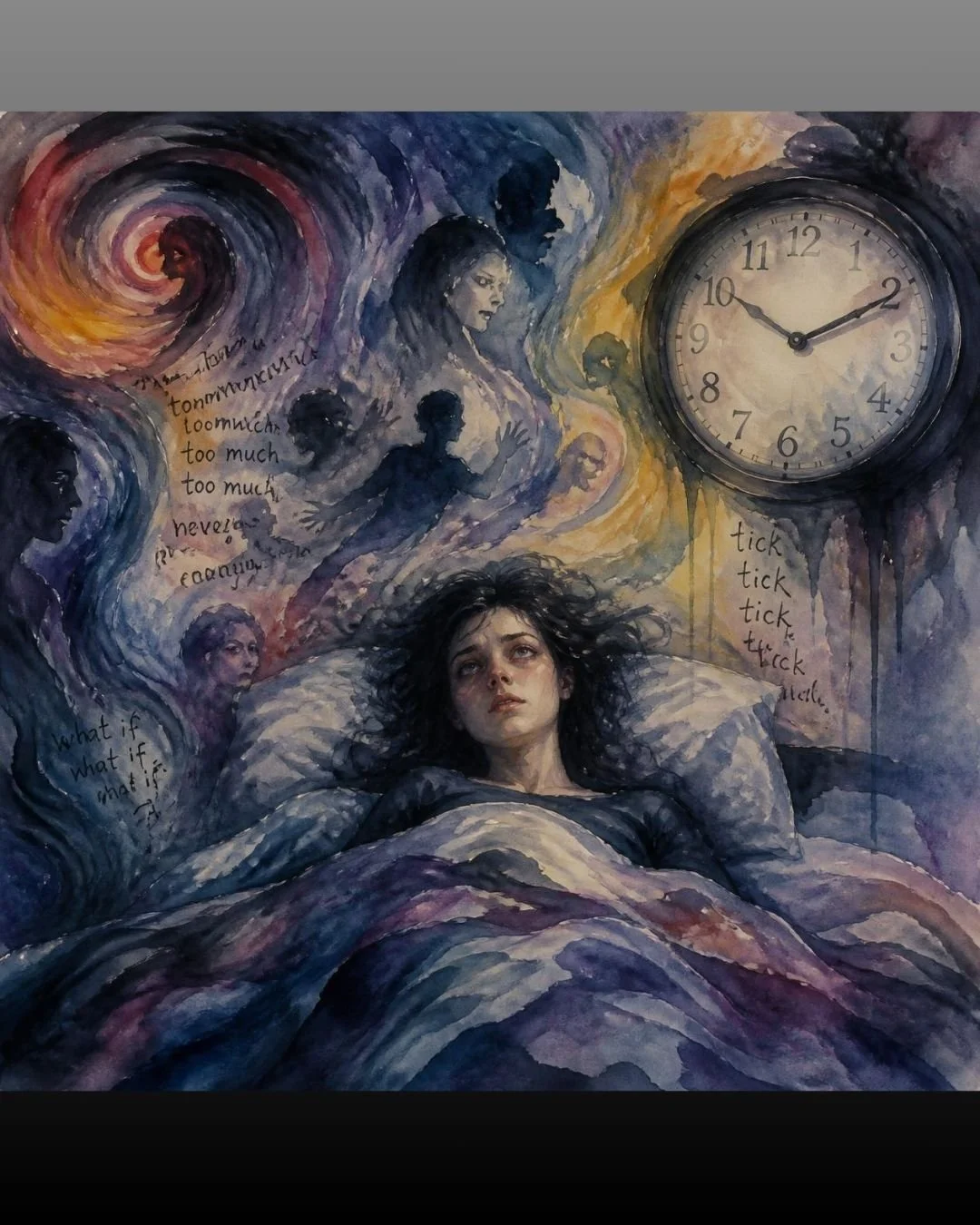
A moody watercolor painting of a woman lying wide awake in bed, staring blankly upward with an expression of exhaustion or anxiety. Swirling around her head are dark, colorful clouds filled with ghostly silhouettes, anxious faces, and repetitive handwritten phrases like "too much" and "what if." On the wall behind her, a large clock looms with the words "tick tick tick" dripping down beneath it, capturing the feeling of insomnia and racing thoughts.
By Cristina Louk, Ph.D., LMHC, ACS, CYT | Peace Humanistic Therapy, PLLC
Quick answer: ADHD is not simply a disorder of attention; it is, for a substantial subset of those who carry the diagnosis, a disorder of timing. Adults with ADHD show a consistently delayed circadian rhythm, meaning their internal clock runs later than the clock of the surrounding world (Coogan & McGowan, 2017; Van Veen et al., 2010). When a history of trauma is layered onto this biology, the nervous system's own alarm system, the hypothalamic-pituitary-adrenal (HPA) axis, becomes dysregulated in ways that further scramble the timing of sleep, wakefulness, and stress hormone release (HPA axis function and diurnal cortisol in PTSD). The result is not a person who lacks discipline. It is a person carrying two independent, biologically documented disruptions to the same regulatory system, each one amplifying the other.
Introduction: Beyond "Just Go to Bed Earlier"
Few pieces of advice land as poorly with adults with ADHD as the suggestion that they simply need better sleep hygiene. Turn off the screens. Keep a consistent bedtime. Avoid caffeine in the afternoon. These recommendations are not wrong; they are simply incomplete because they assume a nervous system whose internal clock is set to the same time as everyone else's. For many adults with ADHD, and for a great many more when a trauma history is part of the clinical picture, this assumption does not hold. The lights can be off, the room can be quiet, and sleep still will not come, not because of poor choices, but because the biological signal that tells the brain "it is time to sleep now" has not yet arrived (Van Veen et al., 2010).
This article examines the research on circadian rhythm disruption in ADHD, the parallel and independent research on trauma's effects on the HPA axis and sleep architecture, and what happens clinically when both are present in the same client. The aim is to offer clinicians, supervisees, and clients a biologically grounded explanation, not another behavioral checklist, for why sleep and energy regulation remain so persistently difficult for this population.
The ADHD Circadian Phenotype: A Clock Set to Run Late
The circadian system is governed by a master clock in the suprachiasmatic nucleus of the hypothalamus, which synchronizes nearly every physiological rhythm in the body, including core body temperature, cortisol secretion, and the nightly release of melatonin, to a roughly 24-hour cycle (Coogan & McGowan, 2017). In a landmark systematic review of 62 studies encompassing 4,462 patients, Coogan and McGowan (2017) found consistent evidence that ADHD is associated with an evening chronotype and with a phase delay of key circadian markers, including dim light melatonin onset (DLMO) and delayed sleep onset. This was not a scattered or inconsistent finding across a handful of small studies; it was a convergent pattern across more than six decades of accumulated research.
DLMO, the point in the evening at which melatonin begins to rise in the body and signals biological nighttime, typically occurs around 9:30 p.m. in the general population, with sleep following roughly two hours later (Onderzoek Met Mensen, n.d.). In adults with ADHD, Van Veen et al. (2010) documented a mean DLMO of 11:15 p.m.; in adults with ADHD and comorbid sleep-onset insomnia, this shifts later still, to just after midnight. A more recent perspective synthesis places the magnitude of this delay at approximately 90 minutes in adults, compared with roughly 45 minutes in children, alongside blunted and delayed cortisol rhythms and attenuated peripheral clock-gene expression (ADHD as a circadian rhythm disorder, 2025). Put simply, the biological signal that tells an adult with ADHD it is time to sleep does not arrive until well after the culturally sanctioned bedtime has already passed. Telling this person to "just go to bed earlier" is, physiologically speaking, akin to telling someone to digest a meal they have not yet eaten.
This delay is not benign background noise. As many as 78% of adults with ADHD demonstrate an objectively delayed circadian rhythm, and insomnia or significant sleep disturbance is reported by 70% to 82% of children and adults with the diagnosis (ADHD as a circadian rhythm disorder, 2025; Fargason et al., 2017). Critically, standard first-line pharmacological treatments for ADHD, namely stimulant medications, do not correct this underlying circadian delay and may, in some cases, compound it (Fargason et al., 2017). Chronotherapeutic interventions, by contrast, including melatonin administered at a precisely timed low dose and morning bright light therapy, have been shown to advance DLMO and to produce measurable reductions in ADHD symptom severity (Fargason et al., 2017; van Andel et al., 2022). This is a meaningful clinical finding: when the circadian phase is corrected, not just the sleep improves, but the attentional and behavioral symptoms of ADHD improve as well, suggesting that circadian misalignment is not merely a comorbidity riding alongside ADHD, but a mechanism contributing to it.
Trauma's Independent Assault on the Body's Clock
Trauma, and particularly the chronic, relational, and often early-onset trauma that characterizes much of the clinical population served in trauma-informed practice, exerts its own well-documented influence on circadian and neuroendocrine timing, entirely independent of any ADHD diagnosis. The HPA axis, the body's central stress-response system, governs the release of cortisol in a rhythm that should peak sharply within the first hour after waking and decline steadily across the day, reaching its lowest point during sleep (HPA axis function and diurnal cortisol in PTSD). In posttraumatic stress disorder (PTSD), this rhythm is reliably disrupted, though the literature reflects some inconsistency in the direction of that disruption, with some studies documenting blunted morning cortisol and others documenting elevated evening cortisol, a pattern the field broadly interprets as evidence of a dysregulated, rather than uniformly suppressed or elevated, stress axis (HPA axis function and diurnal cortisol in PTSD).
Sleep itself is not a passive backdrop to this dysregulation; it is an active participant in it. Sleep onset ordinarily exerts an inhibitory effect on cortisol secretion, while nighttime awakenings and the transition to wakefulness are accompanied by cortisol stimulation (Balbo et al., 2010). In a polysomnographic study assessing PTSD patients with simultaneous blood sampling, researchers found that HPA axis activity was directly related to sleep fragmentation and that sympathetic nervous system activation remained elevated throughout the night, keeping the body in a state of physiological vigilance even during sleep. This is the biological signature of hypervigilance translated into the sleep laboratory: a nervous system that does not fully stand down, even when the environment is, by every external measure, safe.
Trauma's fingerprint is also visible in sleep architecture itself, meaning the structure and sequencing of sleep stages across the night. Rapid eye movement (REM) sleep, the stage most closely tied to emotional memory processing, appears disproportionately affected in trauma survivors, with elevated norepinephrine during REM disrupting the neurochemical conditions ordinarily needed for the nervous system to process and file away distressing material. One study of individuals with idiopathic nightmares found that early childhood adversity was independently associated with adult nightmare severity and with disruption of sleep spindle activity, a pattern the authors noted closely resembled the sleep architecture seen in PTSD, even in the absence of a formal PTSD diagnosis (Weber & Wetter, 2022). In other words, the sleep of a trauma survivor is not simply shorter or lighter; it is structurally reorganized around a threat-monitoring system that has not yet received the signal that the threat has passed.
The Double Hit: Why ADHD and Trauma Together Are Not Simply Additive
When ADHD and a trauma history coexist in the same individual, and clinically they very often do, the two conditions do not sit side by side as separate problems affecting separate systems. They converge on the same regulatory architecture: the circadian clock and the HPA axis that keeps time with it. ADHD delays the biological signal for sleep onset (Van Veen et al., 2010). Trauma destabilizes the cortisol rhythm that is supposed to organize wakefulness and rest around that signal, and fragments the sleep architecture that would otherwise allow the nervous system to recover once sleep is finally achieved (Balbo et al., 2010). The client is not simply falling asleep late; the client is falling asleep late, into a nervous system that remains on watch, and waking into a cortisol rhythm that was never given the chance to properly reset.
This is why the language of "sleep hygiene" so often fails this population, and why so many clients arrive in the therapy room having already tried, and failed, every conventional recommendation. Sleep hygiene interventions are designed to correct behavioral obstacles to sleep occurring at a biologically appropriate time. They are not designed to correct a biological clock that is running ninety minutes behind schedule, nor are they designed to calm a stress-response system that has learned, often for good reason, that stillness and darkness are not synonymous with safety. Clinicians working with this population owe their clients a formulation that accounts for both mechanisms, not a repetition of advice the client has almost certainly already tried.
Clinical Implications: Toward a Biologically Informed, Trauma-Sensitive Sleep Framework
A biologically literate approach to sleep in ADHD with comorbid trauma begins with reframing the presenting problem. Rather than asking why the client cannot maintain discipline around bedtime, the more accurate clinical question is why the client's nervous system has not yet received, or cannot yet trust, the signal that it is safe to power down. Several implications follow from this reframing.
Circadian phase, not willpower, is often the first target. Where clinically appropriate and in coordination with prescribing providers, chronotherapeutic approaches such as precisely timed low-dose melatonin and morning bright light exposure have empirical support for advancing DLMO and reducing ADHD symptom severity (Fargason et al., 2017; van Andel et al., 2022). These interventions work with the biology rather than against it.
Trauma-informed sleep work must address felt safety before it addresses timing. A nervous system that experiences nighttime stillness as a return to old danger, rather than as an invitation to rest, will not be reassured by an earlier bedtime alone. Somatic and body-based interventions, consistent with the embodied approaches long central to this author's clinical and pedagogical work, can help restore the sense of physiological safety that circadian correction alone cannot provide.
Psychoeducation is itself an intervention. Many clients carry significant shame around their inability to sleep on a "normal" schedule, having internalized years of being told they are lazy, undisciplined, or simply not trying hard enough. Naming the biology, the documented DLMO delay in ADHD (Van Veen et al., 2010), the documented HPA axis and sleep architecture disruption in trauma, can itself reduce shame and increase engagement with treatment.
Assessment matters. A thorough clinical picture should not stop at symptom checklists for ADHD or PTSD in isolation; it should include a sleep and chronotype history sufficient to identify whether circadian delay, trauma-related hyperarousal, or both are contributing to the presenting difficulty. This distinction has direct implications for treatment sequencing and referral, including whether a sleep medicine or chronobiology referral is indicated alongside psychotherapy.
Conclusion
The clinical narrative that frames disrupted sleep in ADHD as a failure of discipline, or that frames disrupted sleep in trauma survivors as simple anxiety, does a disservice to the biology underlying both. The research is consistent and, at this point, difficult to dismiss: ADHD is associated with a genuinely delayed circadian clock, documented at the level of melatonin secretion itself (Coogan & McGowan, 2017; Van Veen et al., 2010), and trauma independently and measurably dysregulates the HPA axis and the architecture of sleep. When these two conditions coexist, as they so often do in the adults who seek out trauma-informed, neurodivergence-affirming care, the resulting sleep disruption is not a character flaw to be corrected through greater effort. It is a double hit to the same regulatory system, and it deserves a treatment approach equal to its complexity.
References
Balbo, M., Leproult, R., & Van Cauter, E. (2010). Impact of sleep and its disturbances on hypothalamo-pituitary-adrenal axis activity. International Journal of Endocrinology, 2010, Article 759234. https://doi.org/10.1155/2010/759234
Childhood trauma and sleep issues: Unraveling the connection and finding healing. (2026). Neurolaunch. https://neurolaunch.com/childhood-trauma-and-sleep-issues/
Coogan, A. N., & McGowan, N. M. (2017). A systematic review of circadian function, chronotype and chronotherapy in attention deficit hyperactivity disorder. ADHD Attention Deficit and Hyperactivity Disorders, 9(3), 129–147. https://doi.org/10.1007/s12402-016-0214-5
Fargason, R. E., Fobian, A. D., Hablitz, L. M., Paul, J. R., White, B. A., Cropsey, K. L., & Gamble, K. L. (2017). Correcting delayed circadian phase with bright light therapy predicts improvement in ADHD symptoms: A pilot study. Journal of Psychiatric Research, 91, 105–110. https://doi.org/10.1016/j.jpsychires.2017.03.0
Luu B and Fabiano N (2025) ADHD as a circadian rhythm disorder: evidence and implications for chronotherapy. Front. Psychiatry 16:1697900. doi: 10.3389/fpsyt.2025.1697900
Onderzoek Met Mensen. (n.d.). Phase shift in adult ADHD of sleep and appetite. https://onderzoekmetmensen.nl/en/node/46908/pdf
van Andel, E., Bijlenga, D., Vogel, S. W. N., Beekman, A. T. F., & Kooij, J. J. S. (2022). Attention-deficit/hyperactivity disorder and delayed sleep phase syndrome in adults: A randomized clinical trial on the effects of chronotherapy on sleep.
van Liempt, S., Arends, J., Cluitmans, P. J., Westenberg, H. G., Kahn, R. S., & Vermetten, E. (2013). Sympathetic activity and hypothalamo-pituitary–adrenal axis activity during sleep in post-traumatic stress disorder: A study assessing polysomnography with simultaneous blood sampling. Psychoneuroendocrinology, 38(1), 155-165.
Van Veen, M. M., Kooij, J. J. S., Boonstra, A. M., Gordijn, M. C. M., & Van Someren, E. J. W. (2010). Delayed circadian rhythm in adults with attention-deficit/hyperactivity disorder and chronic sleep-onset insomnia. Biological Psychiatry, 67(11), 1091–1096. https://doi.org/10.1016/j.biopsych.2009.12.032
Weber, F. C., & Wetter, T. C. (2022). The many faces of sleep disorders in post-traumatic stress disorder: An update on clinical features and treatment. Neuropsychobiology, 81(2), 85-97.
Cristina Louk, Ph.D., LMHC, ACS, RYT, is the founder of Peace Humanistic Therapy, PLLC, a private practice specializing in adult ADHD, late-identified neurodivergence, and complex trauma.
