

When ADHD Enters the Relationship: Why Connection Can Feel Harder to Maintain in Adulthood
When adult ADHD enters a relationship, the most painful challenges often stem not from a lack of care, but from how executive-function differences, working-memory gaps, and emotional dysregulation are interpreted by others. Behaviors such as missed messages, chronic lateness, or emotional reactivity can easily be misread as indifference or moral failure, trapping couples and friends in cycles of blame, shame, and withdrawal.
True relational repair requires moving away from moral judgment and toward functional understanding. By externalizing memory and planning, establishing explicit expectations, addressing emotional regulation, and building intentional repair into daily interactions, adults with ADHD and their loved ones can foster intimacy and connection based on mutual accountability, practical support, and accurate understanding rather than accumulated shame.

Should I Ask for Accommodations or Disclose My ADHD at Work?
Deciding whether to disclose ADHD at work is rarely a simple yes-or-no decision. For some people, disclosure can open the door to meaningful accommodations, greater understanding, and a more sustainable way of working. For others, sharing a diagnosis may create unwanted scrutiny, stigma, or assumptions about their abilities.
The decision does not have to begin with, “Should I tell my employer that I have ADHD?” A more useful starting point may be, “What is making my work harder than it needs to be, and what support would help?”
You may be able to address some workplace barriers without disclosing a diagnosis at all. In other situations, formal accommodations may provide important and necessary support. Understanding the difference between asking for a change at work and disclosing a diagnosis can help you make a decision that protects both your privacy and your ability to function effectively.
In this article, I explore the potential benefits and risks of ADHD disclosure, alternatives to full disclosure, workplace accommodations, and the questions worth considering before deciding what is right for you.
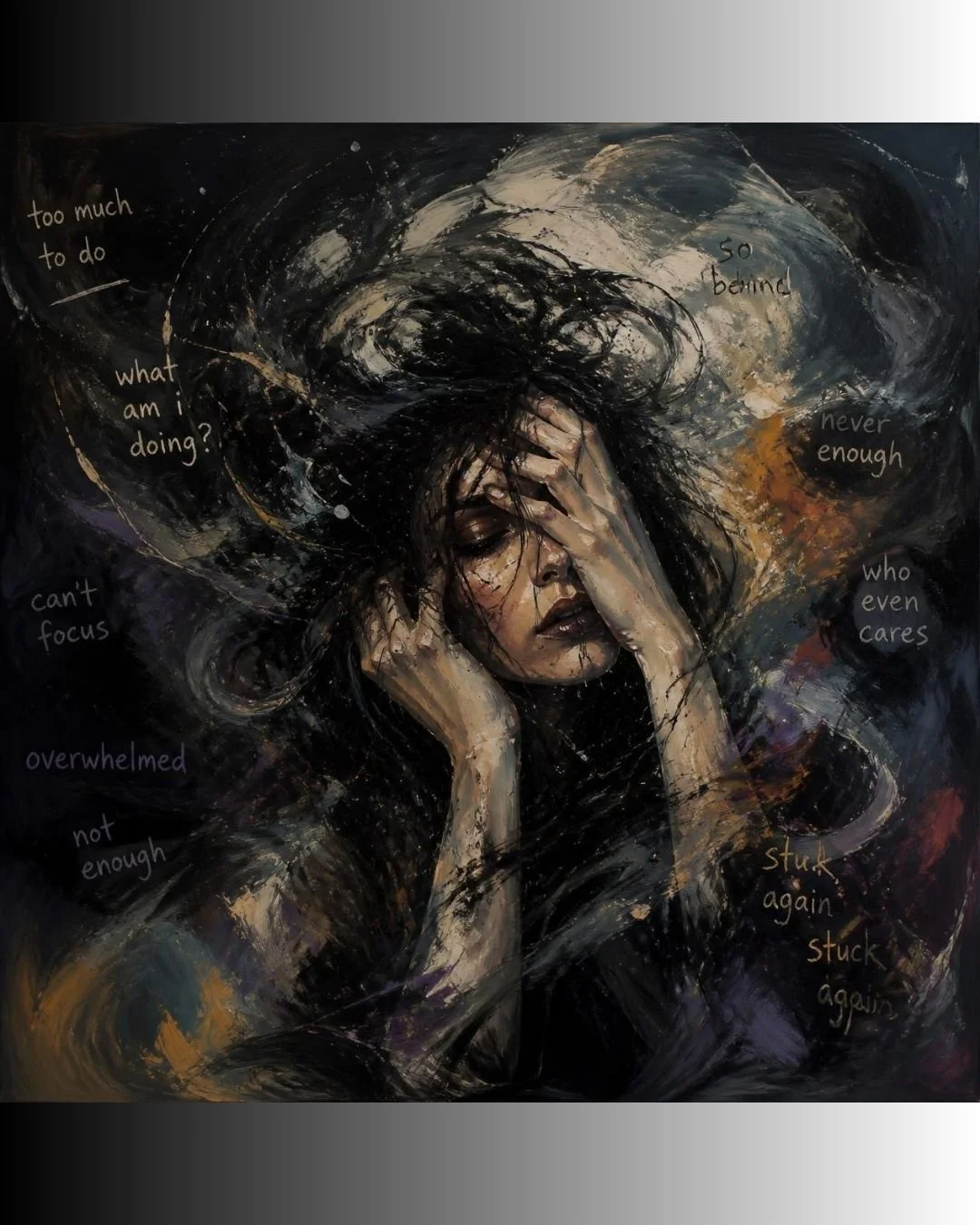
Is It ADHD or Anxiety? How to tell the difference, and when you can have both.
Struggling with concentration, restlessness, or procrastination, but unsure if the root cause is ADHD or anxiety? While both conditions can disrupt executive functioning and leave you feeling overwhelmed, they stem from different underlying mechanisms. Discover how to evaluate symptom patterns, mindsets, and developmental history to better understand what is driving your difficulties—and why it is so common to experience both.

Can ADHD Get Worse With Age? Why Adult ADHD Can Feel Harder in Midlife
Does ADHD Get Worse With Age? Why Adult ADHD Can Feel Harder in Midlife
While research shows core ADHD symptoms typically decrease across adulthood, many adults experience midlife as significantly more challenging. This increased struggle rarely stems from a worsening of the disorder itself. Instead, it is often driven by the loss of external structure, an accumulation of complex professional and personal responsibilities, and the eventual breakdown of long-term compensatory masking. Factors like chronic stress, sleep disruptions, normal cognitive aging, and midlife hormonal shifts can further strain executive functioning, making existing vulnerabilities feel far more severe.

ADHD Paralysis: Understanding Why You Can Know What to Do and Still Feel Unable to Begin
There is a particular experience that many adults with ADHD describe with considerable frustration: they know what needs to be done, understand why it needs to be done, and may genuinely want to complete it, yet they cannot seem to initiate the behavior necessary to get started... ADHD paralysis generally refers to the subjective experience of being unable to initiate or engage in an intended activity despite recognizing that the activity needs to be completed.

ADHD and Friendship in Adulthood: Why Connection Feels So Hard, and What Happens When Trust Gets Exploited
If you have ADHD, adult friendship often feels like a cycle of excitement, executive function exhaustion, and quiet grief. Research shows this isn't a personal flaw—it is a documented pattern rooted in communication mismatches, the cognitive toll of masking, and situational vulnerabilities that make neurodivergent trust easy to exploit. Understanding these dynamics is the first step toward building relationships that actually honor how your brain works.
Beyond Deficits: Toward a Meaning-Making Framework for Adult ADHD Care
A person can become measurably more functional through symptom-focused treatment and still feel fundamentally broken. Why standard adult ADHD care leaves identity-level wounds untouched—and how an integrated framework of logotherapy, narrative therapy, and neuroaffirmative practice offers true psychological repair. Read an excerpt from Part Four of this ongoing series.

Adult ADHD: A Multi-Domain Clinical Reality
It is never just one thing. For adults with ADHD, the research documents what clinicians who work with this population already know intuitively: impairment does not stay contained within a single domain. An occupational setback becomes a relational strain. A relational strain becomes a depressive episode. A depressive episode compounds executive dysfunction — and the cycle continues. Bogdańska-Chomczyk et al. (2025) call this cascading impairment, and it is one of the most clinically significant — and most underaddressed — realities of adult ADHD in practice.

Adult ADHD: Bridging the Research-Practice Gap Through Developmentally Informed Assessment and Treatment
Somewhere between the research and the referral pad, adult ADHD got lost. Not because the science was weak — because the field was not looking. Cortese et al. (2025) confirm that up to 70% of individuals with childhood-onset ADHD continue to experience impairing symptoms as adults, even when full diagnostic criteria are no longer met. The clinical burden persists. What changes is how it presents — and how readily it gets missed.

ADHD and Workplace Productivity: Why Traditional Systems Fall Short
Many traditional productivity systems—such as Getting Things Done (GTD), the Pomodoro Technique, and rigid 9–5 schedules—fail adults with ADHD because they rely on stable attention, working memory, and accurate time perception. Research shows that executive dysfunction and “time blindness” create a structural mismatch between ADHD brains and conventional workplace expectations. In this article, I examine the science behind ADHD and workplace productivity, explore why burnout is so common, and discuss what neurodivergent-affirming productivity actually requires.

Why Adults With ADHD Are So Often Misunderstood in Relationships
Adults with ADHD are often misunderstood in relationships—not because of a lack of care, but because of differences in communication, working memory, and emotional processing. This article explores relationship distress in ADHD through a neuropsychological lens, highlighting why misunderstanding is common and how reframing these patterns can reduce shame and improve connection.

Reconceptualizing ADHD Burnout: A Nervous System Response to Chronic Regulatory Load
ADHD burnout is not a failure of motivation or resilience. It is a nervous system response to chronic cognitive, emotional, and sensory load. This article reframes burnout through a neuropsychological and regulatory lens, distinguishing it from depression and shutdown while highlighting sensitivity as an adaptive early-warning system.

ADHD and Shame: A Relational Story, Not a Personal Failure
For many adults, the heaviest burden of ADHD isn’t distractibility—it’s the cumulative weight of years spent feeling 'out of step.' When neurodevelopmental differences are met with constant correction, the brain stops registering 'mistakes' and starts registering 'rejection.' This article explores the transition of ADHD from a diagnostic criterion to a core identity of shame. By shifting from a narrative of personal failure to an understanding of relational impact and neurobiology, we can begin to replace chronic shame with clinical accuracy and self-compassion.

The ADHD Brain and Justice Sensitivity
For many adults with ADHD, reactions to unfairness or exclusion can feel sudden, overwhelming, and deeply personal. A comment that others brush off lingers for hours. A perceived slight ignites a visceral response before logic has a chance to intervene. These experiences are often dismissed as “overreacting,” yet neuroscience tells a very different story.
The ADHD brain does not process social and moral pain in a muted way. It processes it intensely. Systems responsible for threat detection, emotional salience, and bodily awareness activate rapidly, while the networks responsible for regulation and contextual meaning take longer to come online. What emerges is not fragility, but a nervous system doing its best to protect belonging in environments that have often felt unpredictable or misattuned.
Justice sensitivity and rejection sensitivity are not character flaws. They are adaptive responses shaped by neurobiology, development, and lived experience. When fairness is violated or recognition is withheld, the body reacts first—tightening, heating, bracing—long before the mind can assess intent or nuance. Understanding this sequence is the first step toward healing, not by suppressing sensitivity, but by learning to meet it with awareness, compassion, and regulation.

When Fairness Feels Like a Threat: Justice Sensitivity and the ADHD Nervous System
For many adults with ADHD, fairness is not an abstract value—it is a felt experience. Moments that others may dismiss as minor or inconsequential can register in the ADHD nervous system as emotionally charged, morally urgent, and deeply destabilizing. A broken agreement, inconsistent rules, or witnessing someone being treated unjustly can trigger a cascade of physiological arousal, emotional overwhelm, and meaning-making that feels impossible to shut off.
This response is often misunderstood as overreactivity or emotional rigidity. In reality, it reflects a pattern known as justice sensitivity: a heightened emotional and nervous system response to perceived unfairness. Research suggests that individuals with ADHD experience elevated justice sensitivity across multiple dimensions, closely linked to emotional regulation difficulties, rejection sensitivity, and heightened threat detection. When fairness is violated, the body may respond as if safety itself has been compromised.
This article explores justice sensitivity through a neurobiological and psychological lens, examining why small injustices can feel so big for ADHDers, how justice sensitivity overlaps with Rejection Sensitive Dysphoria, and why these responses are not character flaws but biologically meaningful signals shaped by lived experience. Understanding this pattern opens the door to self-compassion, regulation, and healing—rather than shame.